Continuous improvement · beta
A continuous improvement report for your project, every week.
Kaizora installs a team of AI agents in your repository. They review security, SEO, code, UX, accessibility, performance and business, and leave you a clear report of what they found. No agent touches your code without your OK.
Buy on Gumroad · US$ 20See how it works
v1.0.0-beta.1. Works and tested with Claude Code.
Everything the agents write, including the report, is in Spanish. There is no language option yet.
What's included
A team, a routine and a report.
You get the whole team. Install it in your repository and it works at the pace you choose, daily or weekly.
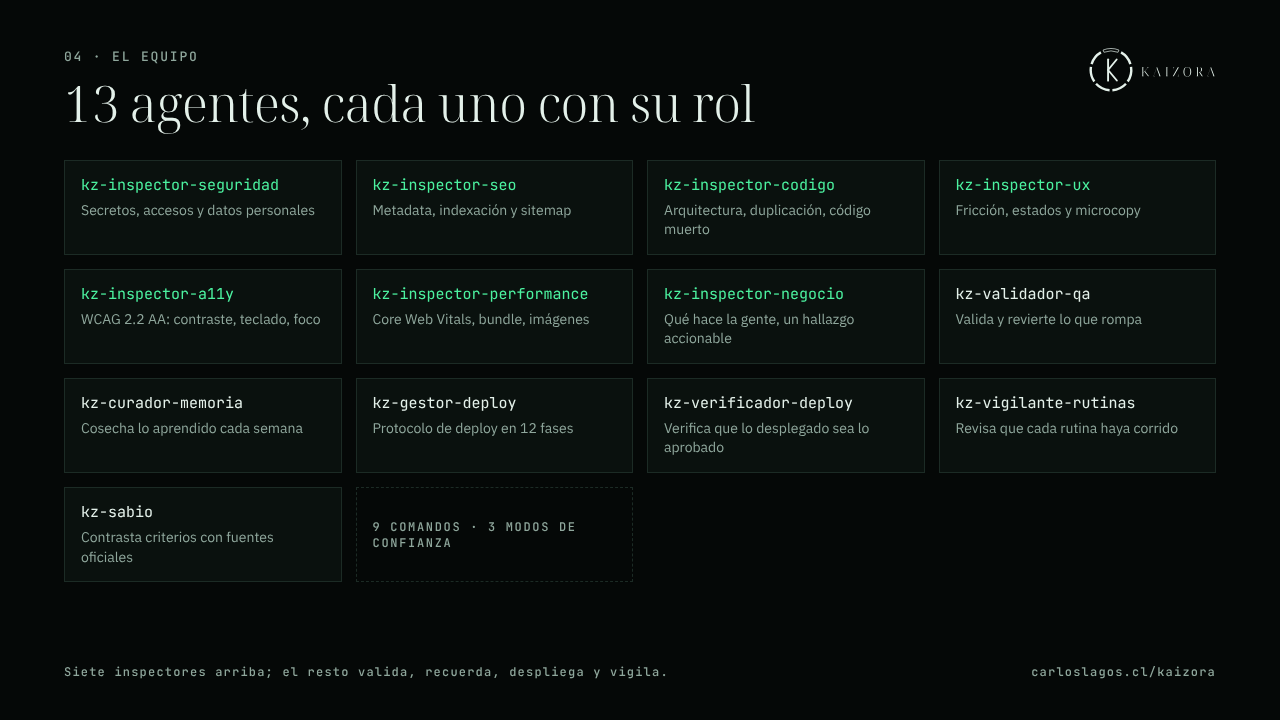
- 13 agents
- Seven inspectors (security, SEO, code, UX, accessibility, performance and business), a QA validator, a memory curator, a deploy manager, a deploy verifier, a routines watcher, and a sage that checks against official sources that each inspector's standards are still current.
- A continuous improvement report
- Self-contained HTML with SVG charts and a summary you can paste into a PR: health by area, trend, what waits for your decision and what the project learned.
- A guard
- It stops the most common agent mistakes: secrets, merges and pushes to production, destructive commands.
- Three trust modes
- Observe, assisted and autonomous. You decide how much to trust.
- 9 commands
- To set up the project, run the cycle, inspect, resolve, build the report, curate memory, turn usability notes into tasks and deploy.
- Stack and business packs
- They give the inspectors context (Node/TypeScript, Python and Rails; marketplace and generic). They are in validation today.
- A playbook of 27 patterns
- On deploys, security, data and looking after the team's memory.
For independent developers, teams of 2 to 10 who already use AI assistants, and agencies that maintain several projects.
How it works
Three steps.
You install once. After that the cycle runs at the pace you choose and you only decide.
- 01
Install in under 10 minutes
It detects your stack and your assistants, installs the agents, turns on the guard and creates your files (
KAIZORA.md, backlog and lessons). With--simularyou see what it would do without writing anything. It never overwrites what you edited, and it starts inobservar(observe) mode. You need Node 20 or later and a project with git. - 02
The inspectors review
Each run inspects one area of the project and logs findings, with evidence, in a prioritized backlog. Every fix leaves a lesson, and every week the memory curator tidies what was learned.
- 03
You decide
The agents fix small things only when you authorize it, and the QA validator reverts anything that breaks. What needs a person is marked in amber in the report, with the word "decision".
Merging is publishing, and a person decides that.
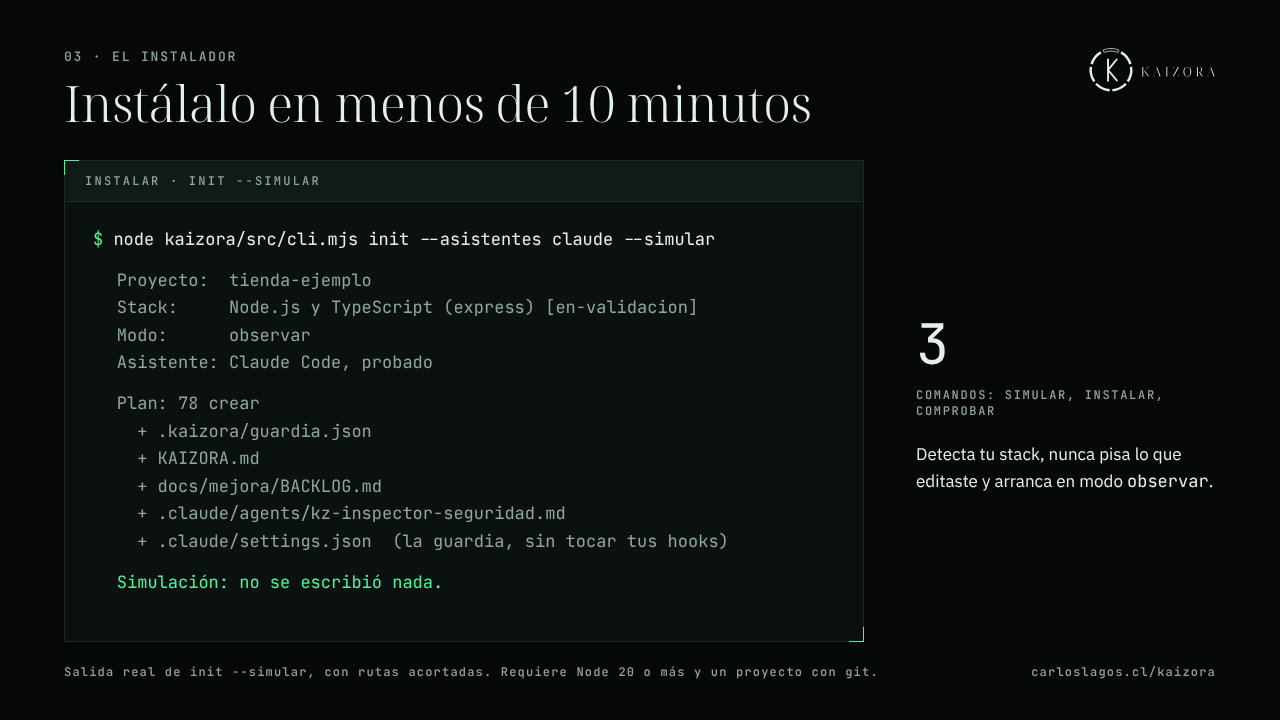
--simular (dry run), with the file list trimmed. The output is in Spanish.The report
Clear at a glance.
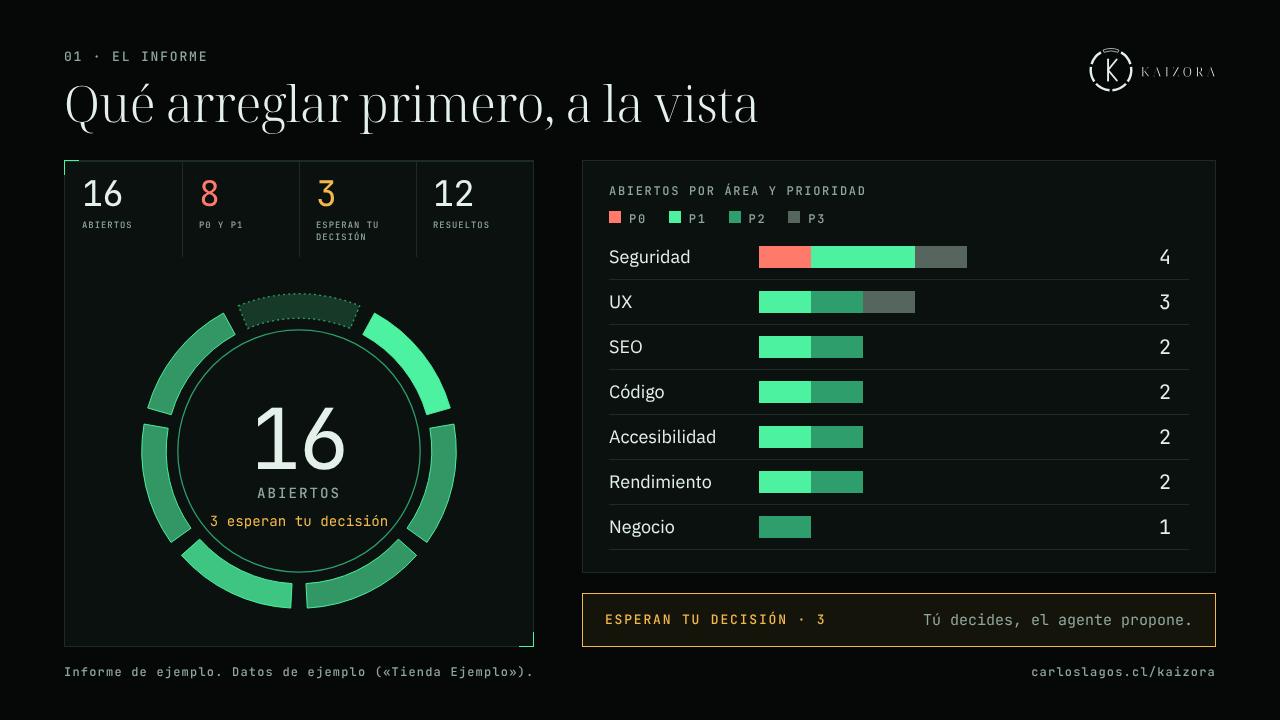
Every week you get a continuous improvement report on your project. It shows how many findings are open and at what priority, in which areas, how the trend is going and what waits for your decision.
The numbers come from your backlog and a script calculates them, not an AI, so there is no made-up score. The ring shows the inspection areas, the bars split findings by priority, the line compares open with resolved, and a separate block gathers what waits for your decision.
See a real one, without buying anything.
This is the report and backlog that came out of running Kaizora's security inspector on OWASP NodeGoat, a public app built to be vulnerable. Each finding has its description, evidence and acceptance criteria. It is one run of one inspector, and NodeGoat is the easy case: it is not an accuracy rate. Both files are in Spanish.
Open the sample reportSee the backlog (Markdown)See the public repository with the figures
NodeGoat belongs to OWASP (Apache-2.0). Kaizora is not affiliated with OWASP.
Control
You decide how much to trust.
Three modes. Changing mode means editing one line of KAIZORA.md.
| Mode | What it does |
|---|---|
observar | The default. Reads and reports only: agents are instructed not to change anything and use the shell only to audit. |
asistido | Fixes small things on a branch for you to review. |
autonomo | Runs on its own in your CI. Only the project owner can turn it on. |
A net against common mistakes.
It is a hook before every tool call, in every assistant that allows it. Without your input, no agent reads .env, keys or credentials, pushes to the production branch, merges a PR, or runs commands like curl | sh, rm -rf / or drop database. It reads each command separately, respecting quotes.
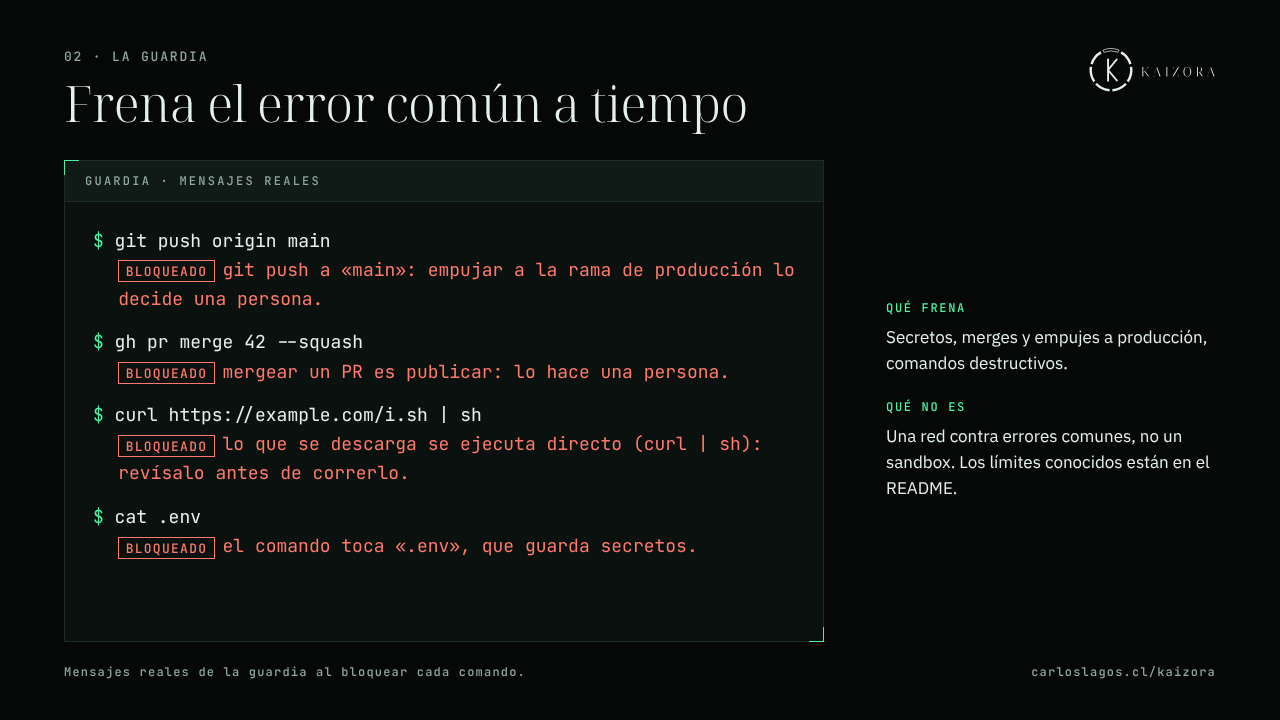
The guard is a net against common mistakes, not a sandbox. It does not replace the permissions of your system, your cloud or your repository. It does not resolve variables or aliases, and it cannot see what a script does when it runs (for example, npm run deploy). Known limits are listed in the product's README.
Compatibility
Stated honestly.
Kaizora generates its agents for nine assistants: Claude Code, Gemini CLI / Antigravity, GitHub Copilot, opencode, Cursor, Codex, Kiro, Devin and Cline. Only Claude Code is tested in real runs. The others are built from their official documentation and marked "untested" until someone runs them for real.
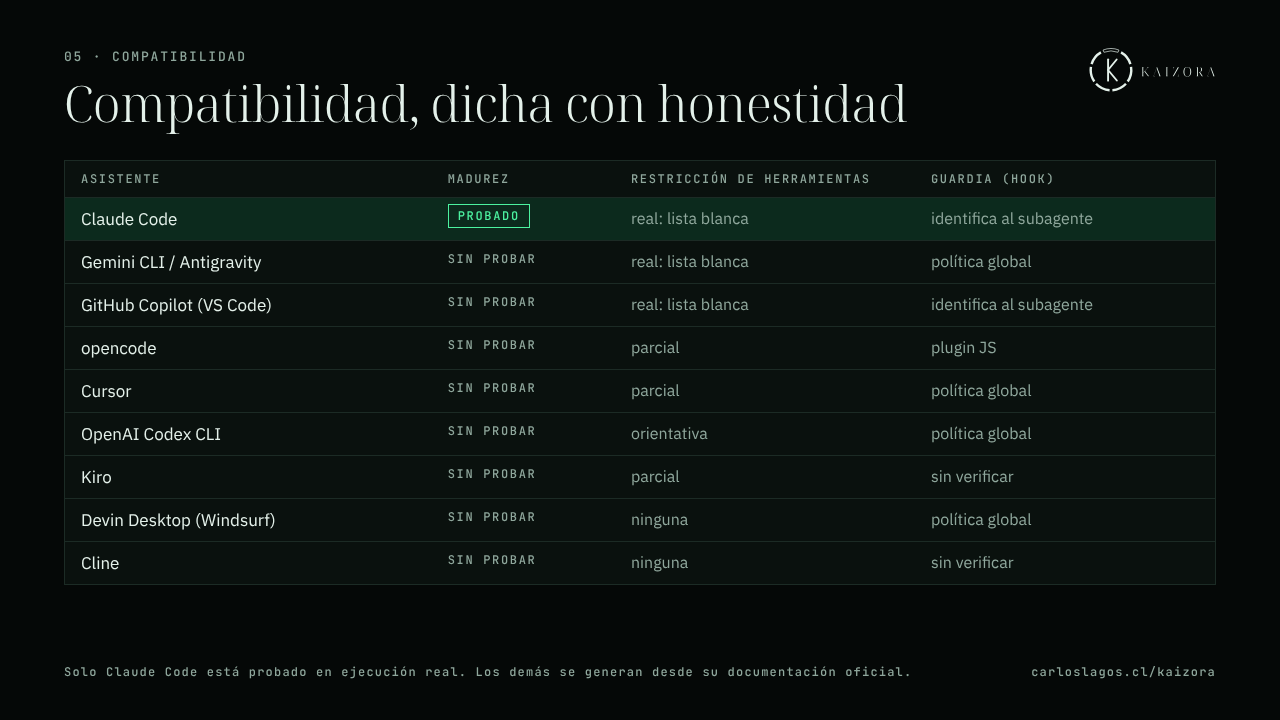
Each assistant restricts tools differently (real, partial, advisory or none). The full matrix ships with the product.
FAQ
What people ask.
Does it work with my stack?
It is designed for any stack. The stack packs (Node/TypeScript, Python, Rails) are in validation, and the only evaluation sample so far was a Node repository.
Do the agents change my code?
In observar mode, no: they only read and report. In asistido, they fix small things on a branch, only when you authorize it. Merging to production is always done by a person.
What does the guard stop, and what doesn't it?
It stops secrets, merges and pushes to production, and destructive commands. It is not a sandbox and has known limits, described in the product's README.
Do I need Claude Code?
It is the only assistant tested today. You can install Kaizora for the others, but they are untested in real runs.
What language does it work in?
Agents, commands, templates and the report are in Spanish, with no language option. The agents can work on a project in any language, but what they write (backlog, report) comes out in Spanish.
How much does it catch?
We don't publish an accuracy rate. We measure against public repositories with known defects, and the product ships one real sample with its limits explained. A finding is a hypothesis with evidence: you decide.
What if it doesn't work for me?
You have 14 days to ask for a refund.
Who owns the output?
What Kaizora generates about your project (reports, backlog, lessons) is yours and you can share it.
Price
US$ 20, one-time payment.
One license per person, for all your projects. Updates to version 1.x are included.
- Commercial license
- 14-day refund
- Sold on Gumroad
Buy on Gumroad · US$ 20US$ 20 · beta
One license per person.
The license is personal: it is not shared with other people, even if they work on your same projects. You can install Kaizora in all your projects and modify the installed copy for internal use. You cannot redistribute it or publish the .kaizora/ folder in an open repository. What Kaizora generates about your project is yours.
The full license ships with the product, in the LICENSE file.